China Top Swing Set Accessories Suppliers for Global Buyers

Swing set accessories may look simple, but their materials, dimensions, and attachment points affect everyday use. A belt swing, toddler seat, climbing rope, or replacement chain must match the frame and intended users. A product photo cannot confirm fit. Buyers should request drawings, load information, material specifications, and clear installation guidance before comparing prices. Details matter.

China’s supplier base includes manufacturers with different product ranges, quality systems, and export experience. A polished catalog is a starting point, not proof of performance. Ask for samples, inspect welds and molded edges, and check whether coatings, fasteners, and ropes are consistently documented. Confirm customization limits, packaging details, lead times, and how defects are handled. Small gaps in communication can become costly once an order is underway.

Play researcher Dr. Stuart Brown has said, “The opposite of play is not work; it’s depression.” That thought helps explain why choosing swing set accessories deserves more care than a quick price comparison. The right shortlist considers fit, finish, documentation, and supplier responsiveness together. No checklist removes every uncertainty. Some product claims still need independent verification. This guide introduces practical questions global buyers can use when evaluating Chinese suppliers, while recognizing that one supplier will not suit every project, budget, or market.
China Top Swing Set Accessories Suppliers for Global Buyers

Understanding Swing Set Accessories and Their Main Categories

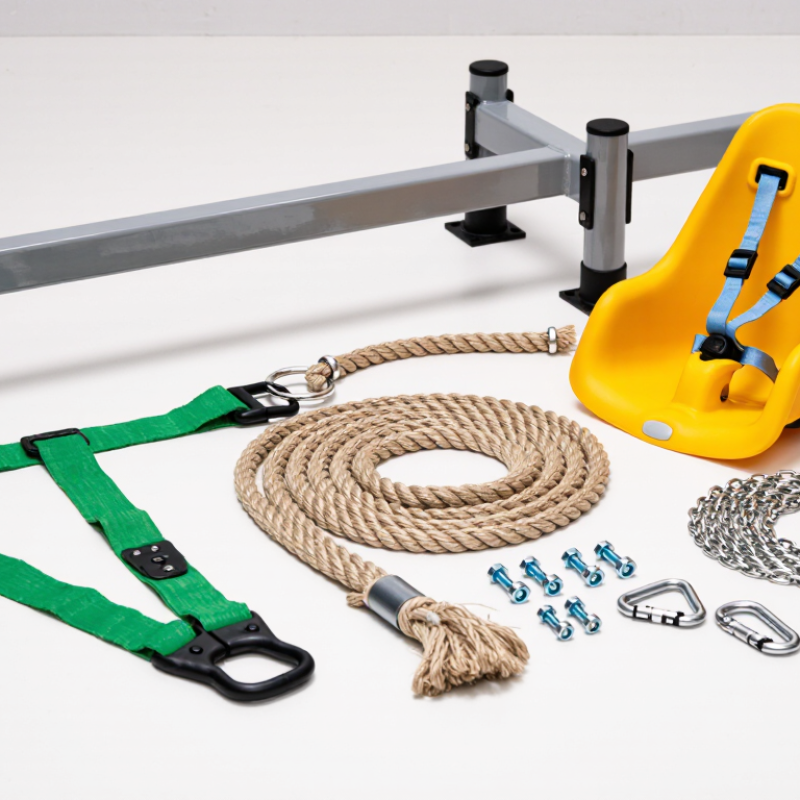
Swing set accessories are the parts that shape how a play structure feels, fits, and performs. Main categories include seats, suspension components, connectors, and add-ons such as grips or footrests. A flat seat suits many older children, while a bucket seat offers more support for younger users. Materials matter. Molded plastic can feel comfortable in warm weather, while rubber-coated seats may provide a softer edge.

Chains and ropes connect seats to the frame, but they are not interchangeable in every setup. Check their length, load rating, coating, and compatibility with the swing hangers. Connectors, including shackles and carabiners designed for playground use, need secure closure and corrosion-resistant construction. Small details count. A poorly matched connector can create noise, wear, or unwanted movement.

For global buyers, clear product specifications make comparison more reliable than appearance alone. Ask suppliers for dimensions, material details, recommended age range, installation guidance, and inspection instructions. Look for smooth edges and hardware that does not pinch fingers. Accessories still need regular checks for cracks, fraying, rust, and loose fasteners. No single material is best for every climate; sun, rain, and salt air change wear patterns. I would not judge a component by a polished sample alone. Real use can expose weaknesses that a catalog photo cannot show.

China’s Swing Set Accessory Supplier Landscape

China’s swing set accessory supplier landscape includes specialized makers of molded seats, metal chains, connectors, ropes, and hardware. Some factories focus on one process, while others coordinate several suppliers and handle final assembly. This variety can give buyers flexibility, but it also makes factory capabilities harder to compare. Ask who makes each component.

For a molded seat, inspect edge finishing, wall thickness, and consistency between samples and production units. For chains and connectors, request material details and corrosion-resistance information. Rope suppliers should explain fiber construction, stitching, and how wear is checked.

Clear inspection records matter. A polished sample alone proves little.

Experienced buyers often request drawings, packaging details, and test documentation before approving a production run. They may also compare sample units from different batches, not just one carefully prepared piece. Communication deserves attention too: vague answers about tolerances or replacement parts can signal gaps in process control. No checklist catches everything. I would still leave room for a small pilot order; it takes time, but assumptions about finish and fit can be wrong.

How to Evaluate and Select a Chinese Supplier

China Top Swing Set Accessories Suppliers for Global Buyers
How to Evaluate and Select a Chinese Supplier

A reliable supplier should show how each swing seat, chain, connector, and fastener is made and checked. Ask for material specifications, batch traceability, and test reports tied to the exact product model. The U.S. Consumer Product Safety Commission’s Public Playground Safety Handbook (2010) reports more than 200,000 annual emergency-room visits for playground-equipment-related injuries among children. That figure makes safety documentation more than paperwork. Check whether testing addresses relevant requirements, such as ASTM F1487 or EN 1176, for your market and product type. A certificate alone is not proof that every shipment matches the tested sample.

Review the factory’s process, not just its catalogue. Request clear photos of welds, chain links, and finished coatings, then compare a pre-production sample with the production order. Ask how the supplier controls corrosion protection, sharp edges, dimensions, and packaging damage. Independent inspection can help verify these details before shipment. Factory visits are useful, but a polished tour is not the same as consistent quality. I would also check how quickly the supplier reports defects; that part is easy to overlook.

Tips: Put product specifications, accepted tolerances, inspection steps, and remedies for nonconforming goods in writing. Test a sample under realistic installation conditions. Small details matter. If a supplier resists sharing basic records, pause and ask why.

China Top Swing Set Accessories Suppliers for Global Buyers - How to Evaluate and Select a Chinese Supplier

Supplier evaluation framework for swing seats, ropes, chains, connectors, and related accessories. Suggested weights are a buyer-side scoring model, not industry statistics. Confirm requirements against the product design, destination market, and applicable regulations.

Evaluation Dimension What to Check Evidence to Request Practical Evaluation Benchmark Suggested Weight Buyer Score (1–5)
Product safety and design Age grading, intended use, load limits, pinch and entrapment risks, sharp edges, surface finish, and compatibility of seats, ropes, chains, and fittings. Product specifications, dimensioned drawings, risk assessment, installation instructions, and records of design revisions. Requirements are documented for the exact product configuration and destination market; safety-critical dimensions and load limits are clearly stated. 16%
Standards and regulatory readiness Whether applicable requirements have been identified for the product type and sales market. Examples may include EN 71-8 for certain activity toys for domestic use, ASTM F1148 for home playground equipment, and applicable chemical or children's-product rules. Test reports, declarations or compliance documentation where applicable, product identification, and confirmation that tested samples match the production model and materials. Documents are current, traceable to the offered model, issued by a competent testing organization where testing is required, and relevant to the destination market. Verify scope and applicability independently. 14%
Materials and chemical controls Material grades and coatings for metal parts; polymer, rubber, textile, and rope specifications; restricted substances; corrosion and weathering suitability. Material declarations, supplier specifications, safety data where relevant, coating details, and test results required for the target market. Materials are specified by type and grade rather than generic descriptions, with controlled substitutions and evidence appropriate to the product and market. 12%
Manufacturing capability Processes relevant to the order, such as molding, metal forming, welding, machining, coating, rope assembly, and final assembly. Process flow, equipment list, production-site information, sample parts, and records showing how outsourced processes are controlled. Production methods and actual production location are transparent; critical processes have defined controls and approved work instructions. 12%
Quality management and inspection Incoming-material checks, in-process inspections, final inspection, defect handling, calibration, and corrective actions. Quality procedures, inspection records, sample inspection reports, nonconformance records, and calibration records for relevant measuring equipment. Inspection criteria are written and measurable; defects are recorded and corrective actions can be traced to closure. 12%
Performance and durability testing Testing appropriate to the product, which may include static or dynamic load, fatigue, pull-out, corrosion, UV or weathering, and abrasion testing. Test methods, sample identification, test conditions, results, acceptance criteria, and reports for the relevant components or assemblies. Test plans reflect the intended use and foreseeable conditions; acceptance limits are agreed before production and results are linked to the product specification. 10%
Traceability and change control Ability to identify production batches and control changes to materials, dimensions, processes, subcontractors, and manufacturing sites. Batch or lot coding examples, production records, change-notification procedure, and retention-sample policy if used. Finished goods can be linked to production records, and material or design changes require documented review and buyer approval where agreed. 8%
Production capacity and delivery planning Available capacity, lead-time assumptions, peak-season planning, component availability, and ability to manage order changes. Capacity plan, production schedule for a comparable order, material lead-time information, and contingency arrangements. Lead times are tied to order quantity, approved samples, material availability, and packaging requirements; risks and schedule updates are communicated promptly. 6%
Commercial terms and total cost Quotation scope, tooling charges, minimum order quantities, payment terms, packaging, inspection costs, and pricing validity. Itemized quotation, tooling ownership terms, sample charges, packaging specifications, and written order terms. Compare equivalent specifications and delivery terms; clarify exclusions, tolerances, replacement terms, and ownership of buyer-funded tooling. 5%
Export packaging and logistics Protection against transit damage, carton labeling, packing configuration, shipment documentation, and suitability for the agreed transport mode. Packaging drawings or photos, carton dimensions and gross weight, packing list example, and proposed shipping terms. Packaging is validated against product shape and shipment conditions; labels and shipping documents are reviewed before dispatch. 3%
Communication and responsiveness Clarity and consistency in technical discussions, sample feedback, issue escalation, and written confirmation of requirements. Response records during sampling, meeting notes, named project contacts, and a documented escalation route. Answers are specific and supported by documents or samples; open issues, actions, and deadlines are tracked in writing. 2%
Total suggested evaluation weight 100%

Quality Standards, Safety Testing, and Customization

Global buyers evaluating swing-set accessories from China should ask for evidence, not just catalog claims. The U.S. Consumer Product Safety Commission’s Public Playground Safety Handbook estimated 205,850 emergency-department-treated injuries involving playground equipment in 2001. This is a historical estimate, not a current annual count, but it shows why small components deserve scrutiny. Ask suppliers for material specifications, batch traceability, and reports covering the exact part and intended use. Numbers matter. Public-use and residential equipment may follow different standards, including ASTM F1487 and ASTM F1148. Confirm the applicable scope with a qualified testing laboratory.

Testing should cover more than static load. Request fatigue-cycle results, corrosion resistance for metal fittings, UV-aging data for molded polymers, and checks for sharp edges, pinch points, and entrapment. For swing assemblies, verify chain or rope length, connector compatibility, and clearances against the relevant standard, including EN 1176-2 where applicable. A report on a similar product does not prove a modified design is safe. Customization can still be practical: suppliers may adjust seat width, chain length, color, packaging, or mounting hardware. Require an approved drawing, sample review, and documented change control before production. I would also inspect random samples; paperwork can miss a loose rivet or uneven edge. No test is perfect.

Global Sourcing, Shipping, and After-Sales Support

Global sourcing of swing set accessories works best when specifications are settled before price negotiations. Ask suppliers for material grades, coating details, load-test records, and carton dimensions. A sample should include the actual hooks, connectors, and fasteners—not just a polished catalogue piece. Check whether replacement parts can be ordered separately. Small components are easy to overlook.

Shipping plans need room for disruption. UNCTAD’s Review of Maritime Transport 2024 reported that global maritime trade grew 2.4% in 2023, while containerized trade grew only 0.3%. For buyers, that uneven pace makes a single estimated arrival date a weak planning tool. Compare port options, confirm shipment milestones, and request packaging that prevents metal parts from rubbing through cartons. Keep a modest spare-parts allowance. It helps.

After-sales support should be agreed in writing before production. Set response times for defect reports and ask what photos, batch codes, or inspection records are needed. For example, a buyer receiving a carton with missing bolts should know whether the supplier will send parts by air or include them in the next shipment. That distinction affects installation schedules. Not every supplier handles claims consistently; treat this as a sourcing risk, and verify the process with a small trial order before scaling up.