Choosing the best Tiffin Lunch Box supplier in China requires more than comparing prices and product photos. It requires evidence. UNEP’s Global Waste Management Outlook 2024 estimates that global municipal solid waste may rise from 2.3 billion tonnes in 2023 to 3.8 billion tonnes by 2050. This pressure supports durable, reusable food containers, but the report does not measure lunch boxes directly. That limitation matters.
China remains a major manufacturing base for stainless steel, plastic, and insulated food containers. Reliable suppliers should explain material grades, production capacity, inspection procedures, and export experience. For stainless steel models, buyers should request documentation for food-contact materials, including relevant Chinese standards such as GB 4806.9. Export-focused factories may also provide test reports aligned with EU or United States requirements. Certificates alone are not enough. Batch traceability and independent testing provide stronger reassurance.
The strongest suppliers usually offer practical details. Ask about 304 stainless steel, lid sealing tests, silicone gasket durability, carton protection, and sample approval. A supplier’s minimum order quantity can also reveal its flexibility. It may affect your launch budget more than the unit price. Industry studies, including Smithers’ The Future of Sustainable Packaging to 2028, underline the growing importance of reusable and recyclable packaging systems. However, sustainability claims need proof, not green language. No supplier is perfect. A polished showroom can hide inconsistent welding or delayed communication. This guide compares Chinese Tiffin Lunch Box suppliers through product quality, compliance evidence, customization, pricing, and long-term reliability. Your checklist should remain skeptical. That is often where better sourcing decisions begin.
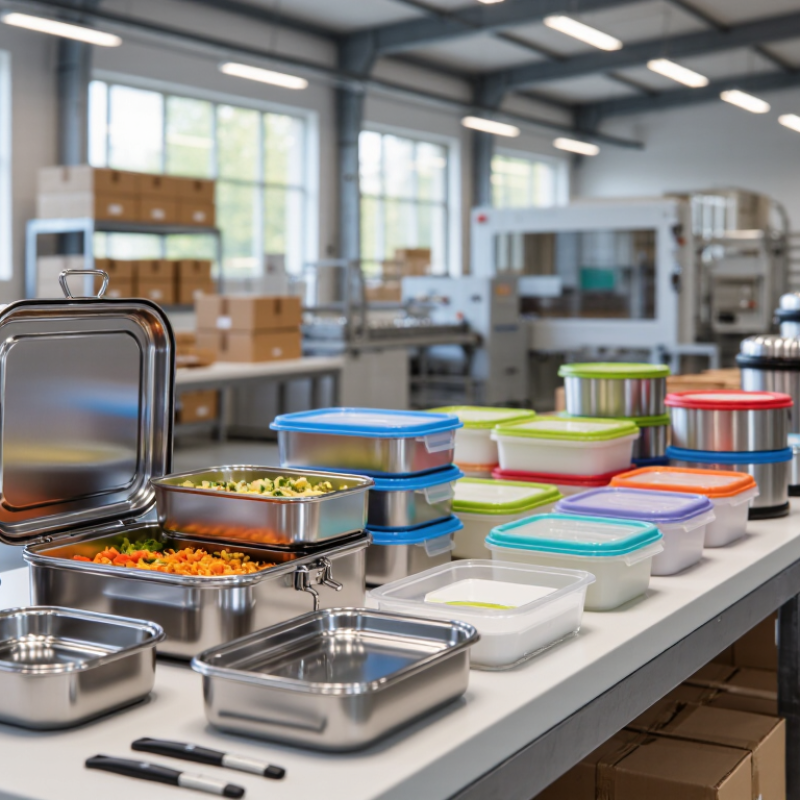
A strong tiffin lunch box supplier offers more than attractive samples. It provides traceable stainless steel, stable welds, and documented food-contact testing.
Grand View Research estimated the global food storage container market at about USD 4 billion in 2023, with continued growth expected through 2030. This growth increases competition, but not every factory improves quality equally.
Ask for material certificates, migration-test results, and production records. A reliable supplier should identify steel grades, gasket materials, and coating specifications for every batch.
Factory audits should review pressing accuracy, lid alignment, and worker training. Practical testing matters too.
Fill each compartment with warm curry, turn the box sideways, and inspect the seal after several hours. Check hinges after repeated opening cycles.
Small details matter.
The best supplier also controls delivery risks. It should provide realistic lead times, approved pre-production samples, and carton drop-test records.
According to the 2024 Supply Chain Resilience Report by the Capgemini Research Institute, many organizations are increasing supplier visibility and risk monitoring after repeated disruptions. That lesson applies to lunch boxes.
A supplier with backup material sources and clear corrective-action reports is safer than one offering only the lowest price.
Some factories report excellent defect rates, yet their sampling methods remain unclear. That deserves questioning.
Experience shows that communication speed, honest reporting, and consistent inspection often matter more than polished showroom samples. A dependable Chinese supplier welcomes difficult questions and keeps evidence ready.
China Best Tiffin Lunch Box Suppliers?
Chinese tiffin lunch boxes usually fall into three practical types: stacked stainless-steel tiers, insulated containers, and microwave-safe plastic sets. Stacked models suit rice, vegetables, and sauces because each layer stays separate. Insulated versions retain heat longer, but performance depends on vacuum quality and lid sealing. Plastic sets are lighter. However, heat resistance and odor retention require careful checking.
Material choice affects safety, weight, and service life. Food-grade 304 stainless steel is widely selected for its corrosion resistance and easy cleaning. The European Food Safety Authority has repeatedly emphasized that food-contact materials must not transfer harmful substances into food. For plastic, buyers should request documented compliance with applicable food-contact standards, not rely on “BPA-free” claims alone. Small details matter, including silicone gasket quality and hinge strength.
The World Stainless Association reports that stainless steel is highly recyclable and remains durable across repeated use. This supports its long-term value, although recycling systems vary by region. Recent food packaging market assessments from Grand View Research identify convenience, reusability, and portion control as continuing demand drivers. Supplier audits should review wall thickness, welds, leak tests, and temperature testing. A shiny surface can hide weak construction. That mistake is easy to make. Product samples should be tested after washing, dropping, and carrying upright. Perfect claims deserve doubt.
| Tiffin Box Type | Common Material | Typical Capacity | Typical Structure | Main Advantages | Best Use | Important Purchasing Checks |
|---|---|---|---|---|---|---|
| Single-Compartment Lunch Box | Food-grade stainless steel, polypropylene (PP), or glass | 500–1,200 ml | One main container with a snap-fit or clip-lock lid | Simple design, easy cleaning, and generally lower production cost | Office lunches, school meals, snacks, and takeaway food | Check lid fit, gasket quality, usable capacity, and whether the container is leak-resistant |
| Stackable Tiffin Box | Stainless steel, commonly 304 grade; PP lids or separators may be added | 700–2,000 ml total | Two to four separate tiers stacked vertically | Separates different dishes and helps organize a complete meal | Rice, vegetables, side dishes, fruit, and multi-course meals | Check tier alignment, locking mechanism, gasket compression, and stability when stacked |
| Bento-Style Compartment Box | PP, stainless steel, glass, or a combination of materials | 600–1,500 ml | Two to five fixed or removable compartments in one container | Keeps foods separated and supports portion control | Balanced meals, meal preparation, school lunches, and portioned servings | Verify whether compartments are liquid-tight; many dividers only separate food without sealing each section |
| Insulated Tiffin Box | Double-wall stainless steel with a vacuum or foam-insulated structure | 500–1,500 ml | Double-wall body with insulated lid; may include one or more inner containers | Slows temperature change and provides a durable exterior | Hot meals, outdoor work, commuting, and travel | Ask for temperature-retention test conditions, wall construction, lid sealing, and condensation control |
| Microwave-Safe Plastic Tiffin Box | Food-contact polypropylene (PP), usually marked with recycling code 5 | 500–1,500 ml | Lightweight container with snap-lock lid and optional steam vent | Light weight, practical for reheating, and available in many shapes | Workplace kitchens, schools, meal preparation, and short-distance transport | Confirm microwave instructions, maximum temperature, food-contact compliance, and lid vent requirements |
| Glass Meal-Prep Box | Borosilicate glass with a PP lid and silicone sealing ring | 600–1,800 ml | Rigid glass base with removable or integrated compartments | Resists food odors and staining; suitable for reheating when specified by the manufacturer | Meal preparation, refrigerated storage, and oven-to-table serving when approved | Check thermal-shock resistance, glass thickness, edge protection, and whether the lid must be removed before heating |
| Electric Heating Lunch Box | PP or stainless-steel food container with an electric heating base | 600–1,500 ml | Removable food tray, heating plate, power cord, and sealed lid | Can warm food where a suitable electrical outlet is available | Factories, offices, vehicles, and workplaces without kitchen facilities | Check rated voltage, plug type, power consumption, overheating protection, waterproofing, and electrical certifications |
| Leak-Resistant Soup Tiffin | Stainless steel or PP body with a silicone gasket and locking lid | 400–1,000 ml | Deep cylindrical or rectangular vessel with gasketed screw or clip lid | Designed for liquids, sauces, soups, and foods with high moisture content | Soup, curry, porridge, yogurt, and liquid-based meals | Require an inverted leak test, gasket inspection, pressure-release evaluation, and clear filling guidance |
China Best Tiffin Lunch Box Suppliers?
How to Evaluate Chinese Tiffin Lunch Box Suppliers
Choosing a Chinese tiffin lunch box supplier requires more than comparing prices. Start by checking factory experience, production capacity, and food-contact material documents. Stainless steel grades should be clearly identified, not vaguely described as “premium steel.” Ask for recent test reports, material certificates, and inspection records. These documents should match the actual product.
Request samples from different production batches. Check lid alignment, hinge strength, seal quality, weld finishing, and odor after washing. Fill each compartment with warm water, turn the box upside down, and observe leakage for several minutes. For insulated models, record temperature changes over time. A polished sample can mislead. Consistency matters more than appearance.
Tips: Ask how suppliers control incoming materials and final inspections. Confirm minimum order quantities, packaging details, replacement policies, and production schedules in writing. A factory audit or independent inspection can reveal crowded work areas, weak traceability, or poor storage conditions. I have learned that fast replies do not always indicate reliable production. Some suppliers communicate well but struggle with quality consistency. Leave room for verification before making a large order.
This buyer-oriented weighting model highlights the main procurement checks: food-contact compliance, leak-proof performance, quality control, commercial terms, delivery capability, customization, and export documentation. Use these percentages as a practical screening framework and adjust them to your product requirements.
China’s leading tiffin lunch box suppliers are concentrated in several manufacturing regions. Zhejiang is known for stainless steel forming, deep drawing, polishing, and metal stamping. Guangdong offers strong plastic injection molding, silicone sealing, and packaging development. Jiangsu and Shandong also support metal fabrication, welding, and large-volume assembly.
Supplier capabilities vary widely. An experienced factory should provide material details, dimensional drawings, sample approval, and food-contact test reports. Stainless steel grades, wall thickness, lid fitting, and seal performance deserve close attention. Some suppliers can develop stackable containers, insulated bodies, custom colors, and private packaging. Others only assemble purchased parts. That difference affects quality control.
Factory visits or independent audits can reveal useful details. Check raw material storage, welding marks, polishing consistency, and leak-testing procedures. Ask how many samples they inspect from each production batch. A reliable supplier should explain corrective actions, not hide defects. No supplier is perfect. A beautiful sample may still conceal weak hinges or uneven seals during mass production. I have found that clear drawings and written tolerances prevent more problems than friendly promises. Buyers should also confirm production capacity during peak seasons, because delivery performance can change quickly. Small details matter.
China Best Tiffin Lunch Box Suppliers?
How to Choose the Right Supplier for Your Business Needs
Choosing a tiffin lunch box supplier in China requires more than comparing prices. Your decision should match your material, volume, packaging, and delivery requirements. Ask whether the factory produces stainless steel, food-grade plastic, or both. Request recent test reports for food-contact safety, heat resistance, and leakage performance. A polished catalog proves very little.
Before placing a large order, buy samples from the same production line. Check the lid seal, hinge movement, compartment fit, and surface finish by hand. Fill each box with warm water and carry it in a tilted bag. This simple test can reveal leaks that photographs hide. Confirm the minimum order quantity, mold charges, replacement policy, and carton dimensions in writing. Ask for production photos, inspection records, and a realistic lead time. Promises are not controls.
A dependable supplier should explain its quality process without vague answers. Look for traceable batch records and clear responses from sales and engineering staff. Independent pre-shipment inspection can protect your budget, especially for first orders. Still, inspection cannot fix poor design or weak communication. I would score suppliers on response speed, sample accuracy, and problem handling, not only quotations. One lesson is easy to miss: the cheapest unit price may create costly packaging damage or delayed launches. Leave room for revision. Your first supplier choice may not be perfect, and that is acceptable if the evaluation process is honest and measurable.